

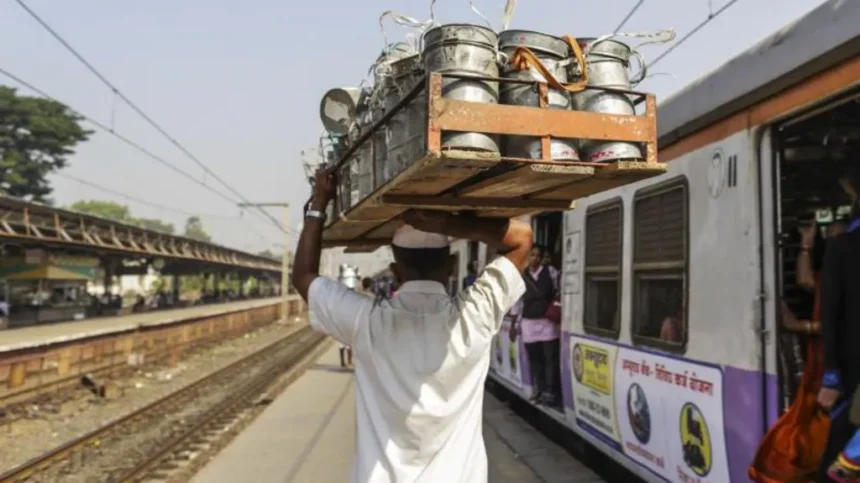
Every morning, long before Mumbai’s office towers fill with workers and commuters crowd the city’s railway platforms, thousands of steel lunchboxes begin a remarkable journey.
They travel across one of the world’s busiest cities through a delivery network that has fascinated business schools, logistics experts, and world leaders for decades.
The men responsible for this extraordinary system are known as dabbawalas.

For more than 130 years, Mumbai’s dabbawalas have performed what many consider one of the most efficient delivery operations in the world. Without smartphones, GPS tracking, barcode scanners, or sophisticated software, they have successfully transported home-cooked meals from suburban kitchens to office workers across the city with astonishing accuracy.
Their work became a symbol of Mumbai itself: disciplined, resilient, dependable, and relentlessly hardworking.
But today, this iconic tradition faces one of the greatest challenges in its history.

The rise of remote work, changing lifestyles, food delivery apps, and economic pressures have dramatically reduced demand for the service that once fed tens of thousands of office workers every day.
Many dabbawalas have already left the profession. Others are struggling to survive by working second jobs. Some fear the next generation may never choose to continue the tradition at all.
What was once celebrated as one of India’s greatest logistical success stories is now fighting for its future.
A System That Amazed the World
The dabbawala system is often described as one of the greatest examples of human-powered logistics ever created.
Every weekday morning, dabbawalas collect freshly prepared lunches from homes across Mumbai’s sprawling suburbs. These meals are packed into metal containers known locally as “dabbas.”
The lunchboxes typically contain traditional Indian meals consisting of rice, vegetables, lentils, rotis, and other homemade dishes prepared by family members earlier that morning.
Each lunchbox is marked with a unique combination of letters, numbers, colors, and symbols.
To outsiders, these markings may appear confusing.
To a dabbawala, however, they provide everything needed to complete the delivery. The codes indicate where the lunchbox originated, which railway route it should follow, which office building it belongs to, and where it should ultimately be returned.
The entire process relies heavily on Mumbai’s suburban railway network.
Dabbawalas collect boxes by bicycle, transport them to railway stations, sort them into groups, load them onto trains, and then distribute them across the city using bicycles, handcarts, and foot deliveries.
By lunchtime, thousands of office workers receive fresh meals prepared just hours earlier in their homes.
Later in the afternoon, the process runs in reverse.
Empty lunchboxes are collected, sorted once again, transported through the railway network, and returned to the correct households before evening.
For generations, this routine has operated with extraordinary consistency.
Business schools around the world have studied the system for its efficiency and reliability. Harvard Business School famously examined the dabbawala network as a case study in operational excellence.
In 2003, even Britain’s future King Charles spent time observing their work during a visit to Mumbai.
Their reputation became legendary.
At a time when many companies struggled with delivery accuracy despite advanced technology, Mumbai’s dabbawalas continued achieving remarkable results using little more than experience, teamwork, and an intimate knowledge of the city.
How the Tradition Began
The origins of the dabbawala system can be traced back to the late nineteenth century when Bombay, as Mumbai was then known, was expanding rapidly under British colonial rule.
As offices, banks, and commercial establishments grew, workers increasingly found themselves far from home during the day.
Restaurants and cafeterias were limited, and many families preferred home-cooked food that matched their dietary habits, cultural traditions, and religious requirements.
According to historical accounts, a Parsi banker is believed to have hired a worker to transport his lunch from home to the office.
The idea proved practical and soon attracted interest from others facing similar challenges.
By 1890, entrepreneur Mahadeo Bachche organized the service into a structured delivery network employing approximately 100 workers.
Over time, the operation expanded alongside Mumbai’s growth.
As the city’s population increased and office districts spread farther apart, demand for reliable meal delivery grew as well.
The dabbawalas adapted continuously, refining their coding systems, transportation methods, and organizational structures.
What began as a simple solution for a handful of workers eventually evolved into one of the most respected delivery systems in the world.
Life at Its Peak
Before the Covid-19 pandemic, the dabbawala network was operating at a scale few people outside Mumbai fully appreciated.
Nearly 4,500 registered dabbawalas were delivering approximately 50,000 lunchboxes every day.
The service was affordable, dependable, and deeply woven into the city’s culture.
For office workers, receiving a home-cooked lunch represented more than convenience.
It provided comfort.
In a city known for long commutes and demanding work schedules, the lunchbox served as a daily connection to family and home.
For dabbawalas, the profession offered stable income and a strong sense of community.
Many workers belonged to families that had participated in the trade for generations.
The work was physically demanding, but it carried dignity and pride.
Few could have predicted how dramatically everything would change in 2020.
The Pandemic Changed Everything
When Covid-19 forced offices across India to close, the foundation of the dabbawala system suddenly disappeared.
Millions of employees began working from home.
Office buildings that once housed thousands of workers stood nearly empty.
The need for daily lunchbox delivery collapsed almost overnight.
For dabbawalas, the consequences were immediate.
Workers who previously served twenty or thirty customers each day found themselves with only a few deliveries.
Some lost all of their customers entirely.
Unlike large corporations, most dabbawalas had limited financial reserves.
Without sufficient income, many were forced to seek alternative employment.
Some became drivers.
Others found temporary labor jobs.
A number left Mumbai altogether in search of opportunities elsewhere.
Although offices have since reopened, the workplace itself has changed permanently.
Remote and hybrid working arrangements remain common across many industries.
Employees who once travelled to offices five or six days a week may now commute only occasionally.
For a delivery system built around daily office attendance, that change has been devastating.
The impact can be seen in the numbers.
The registered dabbawala workforce has reportedly declined from around 4,500 workers before the pandemic to roughly 1,500 today.
For an institution that survived world wars, economic crises, and decades of urban transformation, the decline is unprecedented.