

Introduction
For millions of people around the world, dating apps promised to make finding love easier than ever before.
With a few swipes and a carefully crafted profile, users could instantly connect with hundreds or even thousands of potential partners. What once required chance encounters, introductions from friends, or awkward conversations in public spaces could now happen from the comfort of a smartphone.
The concept seemed revolutionary.

Yet despite having more options than any generation before them, many modern singles report feeling exhausted, frustrated, and emotionally drained by the very apps designed to help them find connection.
What begins as optimism often turns into disappointment. Conversations go nowhere. Matches disappear without explanation. Dates fail to lead to meaningful relationships. Hours spent swiping produce little more than fatigue and self-doubt.
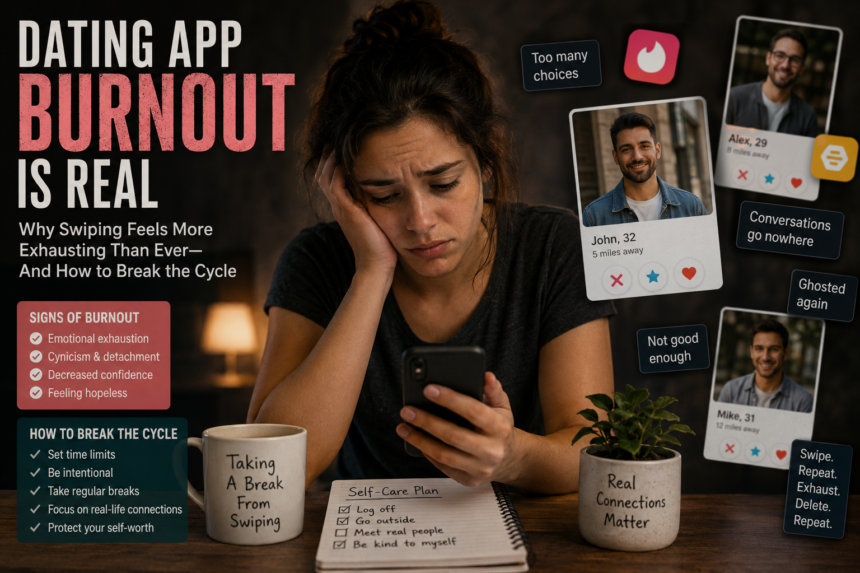
Psychologists now have a name for this growing phenomenon: dating app burnout.

The experience is becoming so common that researchers are beginning to study it in the same way they study workplace stress and emotional exhaustion. Users frequently describe symptoms that resemble professional burnout, including mental fatigue, cynicism, emotional detachment, and a persistent feeling that no matter how much effort they invest, nothing improves.
For many people, the cycle has become painfully familiar.
Download the apps. Feel hopeful. Swipe constantly. Get frustrated. Delete everything. Promise never to return. Then reinstall the apps a few months later and start over again.
The pattern repeats endlessly.
As dating apps continue to dominate modern romance, understanding why burnout occurs and how to prevent it has become increasingly important for anyone navigating today’s digital dating landscape.
The Promise of Modern Dating Apps
When dating platforms first gained popularity, they were marketed as a solution to one of life’s most difficult challenges: meeting compatible people.
Traditional dating often depended on geography, social circles, workplace interactions, or pure luck. Online platforms dramatically expanded opportunities by allowing users to connect with individuals they would never otherwise encounter.
The advantages seemed obvious.
People with demanding careers could date more efficiently. Introverts could avoid uncomfortable social situations. Those living in smaller communities gained access to a much larger dating pool.
For many users, dating apps genuinely worked.
Countless successful relationships and marriages have started through online platforms. Entire families exist today because two people happened to swipe right at the same moment.
However, while dating apps increased access to potential partners, they also fundamentally changed how people experience dating itself.
Instead of focusing on a handful of meaningful connections, users are often exposed to hundreds of profiles every week.
What initially feels exciting can quickly become overwhelming.
The endless stream of options creates new psychological challenges that previous generations never had to face.
Why Dating Apps Feel So Addictive
One reason dating apps can become emotionally exhausting is because they are built around the same engagement principles used by social media platforms and mobile games.
Every swipe offers the possibility of a reward.
A match.
A message.
A compliment.
A potential relationship.
The uncertainty is what keeps people engaged.
Behavioral psychologists have long known that unpredictable rewards create stronger habits than predictable ones. Slot machines operate on this principle, and many experts believe dating apps utilize similar psychological mechanisms.
Users never know when the next swipe will produce a match.
That uncertainty encourages continued engagement.
The result is a cycle where people spend far more time on the apps than originally intended.
What begins as a quick five-minute check can easily become an hour of scrolling through profiles.
Many users report reaching a point where they continue swiping even when they are no longer enjoying the experience.
The habit becomes automatic.
And over time, emotional exhaustion begins to develop.
Understanding Dating App Burnout
Burnout is not simply feeling tired.
Psychologists define burnout as a state of emotional, mental, and sometimes physical exhaustion caused by prolonged stress.
Traditionally, burnout was associated with demanding careers such as healthcare, education, and emergency services.
Researchers now recognize that similar patterns can emerge in other areas of life, including dating.
Dating app burnout generally includes three key components:
Emotional Exhaustion
Users begin feeling mentally drained after repeated swiping, messaging, and unsuccessful interactions.
The excitement that once accompanied matches disappears.
Opening the app feels more like a chore than an opportunity.
Cynicism
Profiles begin to blend together.
People stop viewing potential matches as unique individuals and start seeing them as interchangeable options.
Conversations become less meaningful and more transactional.
Reduced Confidence
Repeated disappointments can create the belief that success is impossible.
Users may begin questioning their attractiveness, communication skills, or overall desirability.
Over time, self-doubt replaces optimism.
Together, these factors create a powerful cycle that becomes increasingly difficult to escape.
The Hidden Emotional Cost of Endless Choice
One of the biggest paradoxes of dating apps is that more options do not always lead to greater satisfaction.
In fact, psychological research suggests the opposite may be true.
When people face too many choices, decision-making becomes more stressful.
This phenomenon is known as choice overload.
Dating apps expose users to an unprecedented number of potential partners.
Instead of evaluating a few meaningful possibilities, users are asked to compare hundreds of profiles.
The result is often analysis paralysis.
People become reluctant to invest fully in one connection because another seemingly better option might appear tomorrow.
Relationships remain stuck in an endless evaluation stage.
The abundance of options creates anxiety rather than confidence.
Ironically, the very feature that makes dating apps attractive may also contribute significantly to burnout.
Why Ghosting Feels So Common
One of the most frustrating aspects of online dating is ghosting.
Conversations begin enthusiastically and then suddenly stop without explanation.
For the person being ignored, the experience can feel deeply personal.
However, many psychologists argue that ghosting is often a consequence of the overwhelming nature of app-based dating rather than deliberate cruelty.
Users frequently manage multiple conversations simultaneously.
As emotional fatigue increases, people start abandoning interactions that require effort.
Responding becomes another task on an already crowded to-do list.
Unfortunately, this behavior contributes to a culture where meaningful communication becomes increasingly rare.
And every ghosting experience adds another layer of frustration for users already struggling with burnout.
Social Media Comparison and Self-Esteem
Dating apps also expose users to constant comparison.
Every profile appears carefully curated.
Photos showcase vacations, achievements, hobbies, and attractive lifestyles.
While users intellectually understand that profiles represent highlights rather than reality, emotional reactions are harder to control.
People naturally compare themselves to others.
Repeated exposure to idealized profiles can negatively impact self-esteem.
Users may begin questioning whether they are attractive enough, successful enough, interesting enough, or worthy enough to find a relationship.
These feelings can gradually contribute to anxiety, loneliness, and emotional exhaustion.
How to Break the Burnout Cycle
The good news is that dating app burnout is manageable.
Experts recommend several practical strategies:
Limit Usage
Set specific time limits rather than swiping endlessly.
Diversify Your Dating Life
Attend events, join clubs, participate in hobbies, and meet people offline.
Focus on Quality Over Quantity
Meaningful conversations are more valuable than dozens of superficial matches.
Take Breaks
Deleting the apps temporarily can help restore perspective and reduce emotional fatigue.
Protect Your Self-Worth
Remember that app outcomes are influenced by algorithms, timing, and countless external factors.
They are not a measurement of your value as a person.
Conclusion
Dating apps have transformed modern relationships in remarkable ways.
They have helped millions of people connect, build relationships, and create families.
However, they have also introduced new psychological challenges that previous generations never experienced.
Dating app burnout is not a personal failure.
It is often a predictable response to an environment built around constant choice, endless evaluation, and uncertain rewards.
Recognizing the signs early can help users maintain healthier relationships with technology while protecting their mental wellbeing.
At the end of the day, successful dating is not about swiping more.
It is about creating genuine human connections, whether they begin online or offline.